
Enid City Directory Collections by Year
Historical Enid directories are a shelf-and-microfilm search, not one complete online database. The Oklahoma Historical Society survey documents R.L. Polk & Co. Enid city directories from 1906 through 1940, and specifically cites 1921 and 1933. The Enid Public Library genealogy desk identifies local directories and newspapers on microfilm, while federal holdings provide another route for selected years. Ask before a trip about the exact edition and whether its address section survives.
| Collection | Years | Where held | Access |
|---|---|---|---|
| R.L. Polk & Co. Enid city directories | 1906-1940 documented | Enid Public Library, OHS survey, and Heritage Center leads | Local consultation or research request; confirm a particular year |
| Enid address sections | Street listings begin in 1923 | Enid library collection | Use the by-address section when it is present |
| NARA Enid directories | 1928, 1930-31, 1933, 1935 | National Archives microfilm holdings | Check item availability for the chosen edition |
| Gateway newspaper collections | Land Run era leads through the 1920s | Gateway to Oklahoma History | Free page images and OCR, with image verification |
A year missing from a shelf does not prove no directory was published. It can mean the local copy did not survive or has not been digitized. The National Archives city-directory listing is especially helpful for the 1928, 1930-31, 1933, and 1935 Enid leads when a local scan is unavailable.
Enid City Directories at the Library Desk
The library is the strongest public starting point for a historical Enid city directory search. Its local-history service points to directories, Land Run-era newspaper microfilm, census sources, Gateway, and staff assistance. The Marquis James Room and genealogy materials are on the second floor. A visitor can view, scan, or photocopy local newspaper and directory material; a remote question works best when it gives an approximate date, a name, and an old or current street wording.
For help, the library lists the research contact at 580-616-7196 and the reference desk at 580-234-6313. Its genealogy page also gives the reference email address. That route is more useful than guessing that every historical volume has a searchable online image. The library's listed main hours are Monday through Thursday 8:30 to 7:00, Friday 8:30 to 6:00, and Saturday 8:30 to 5:00, with Sunday closed. Confirm current hours before visiting.
Note: Give the staff a year range and both name and address variants so they can distinguish a directory question from a newspaper or obituary request.
The library genealogy and local-history page shows the services that support the Enid city directory collection.
The library image reinforces why a directory search can continue into microfilm, census, obituary, and staff-assisted sources instead of ending with one alphabetical listing.
The 1923 Enid City Directory Change
The most important year break in the Enid city directory record is 1923. The OHS historic-resource survey says buildings were not listed by street address before then. A pre-1923 search should begin with a person's name, a business, an occupation clue, a post-office reference, or an addition and lot. It should not force an old name-only listing onto a modern parcel without another record.
From 1923 forward, the by-address section can put a household clue beside a street. Compare it with the alphabetical section, then retain the exact printed spelling and date. If the address appears to change, check a plat, deed, newspaper image, or map before deciding it is the same building. The McKinley Historic District survey is the source for both the 1906 earliest-publication lead and the 1923 address-listing threshold.
That threshold is a practical safeguard. It separates a name search from a true address search and prevents a later street number from being treated as if it were printed in an earlier Enid directory.
Reading Enid City Directory Entries
An Enid city directory entry is evidence of what that volume printed, not a modern identity card. The 1899 Garfield County Democrat directory-like page visibly combines city officers with postal-directory information. It shows names attached to public roles, but it is not a complete resident-by-address card. For a 1921 or 1933 Polk entry, inspect the title page and abbreviation key before treating a mark or shorthand as a fact.
| Name | Record the spelling, initials, and any role exactly as printed. |
|---|---|
| Address or postal clue | Keep the printed wording and distinguish it from a modern parcel address. |
| Organization or work clue | Use it to separate similar names, then confirm with a second source. |
| Public role | The 1899 page lists roles such as mayor, city clerk, treasurer, marshal, and council members. |
| Page image | Save the image and citation because OCR can split names and numbers. |
- Criss-cross directory
- An address-ordered directory section. No complete official Enid reverse-directory run was located, so ask the library or Heritage Center what is on the shelf.
- Householder index
- A name-oriented finding aid for households. It can lead to an address section but does not replace checking that page.
- Abbreviation key
- The volume's own explanation for its short forms. Photograph it before interpreting a shorthand mark.
Gateway's digitized 1899 page provides a real local example of the early Enid city directory material.
The image is a useful reminder to read the page itself, because its public-role and postal material does not establish a complete household listing.
Enid City Directory Newspaper Leads
Newspapers fill gaps between directory editions. The Enid Weekly Wave collection was founded in 1893 and showed 896 items on the inspected collection page, distributed across the 1890s, 1900s, and 1910s. Enid Echo, Enid Enterprise, and Oklahoma Democrat are separate Gateway paths. Search a name or street with a narrow date window, then inspect the scan rather than relying on OCR alone.
A notice, civic roster, obituary, or advertisement may put a person near a directory year. It still needs a date and a second record before it becomes a household conclusion. The December 9, 1893 Enid Enterprise issue is a four-page post-Land Run sample, while the Oklahoma Democrat collection has a documented 1922 to 1925 span in the inspected description.
Gateway's Enid Weekly Wave collection is the digitized newspaper source used for this Enid city directory lead.
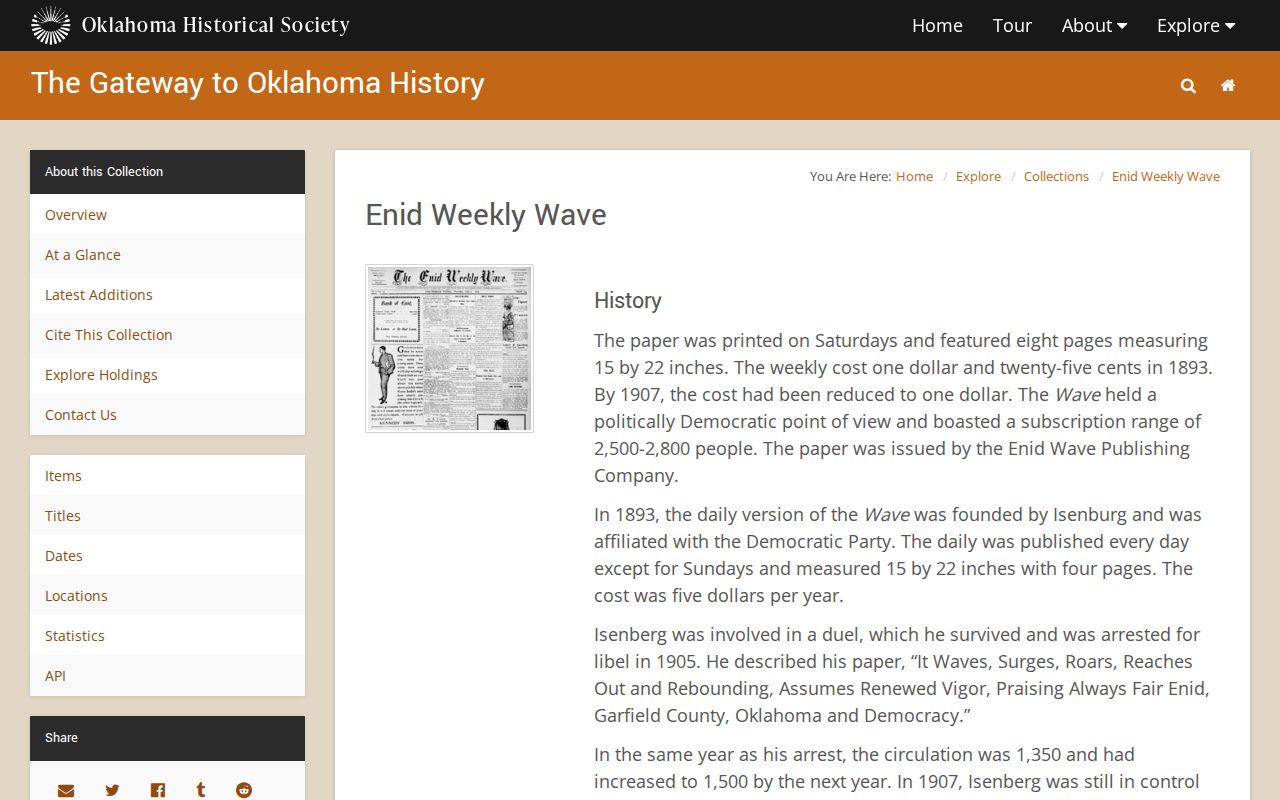
The collection view helps a searcher move from an OCR hit to the original newspaper page and its surrounding notices.
Enid City Directory Map Context
Use maps to test an address, not to name an occupant. The 1925 Enid Sanborn map can show a building footprint, use, story count, construction clues, and street context. OHS material reports Enid map coverage as early as 1894. Pair the map with a directory, newspaper, plat, or deed, since a footprint alone does not show who lived there.
Place labels need the same caution. Old records may say Enid, Enid Station, North Enid, or a postal place that does not align neatly with a modern street. Preserve the original wording in notes. The Enid courthouse story also matters: the 1907 courthouse was destroyed by fire in 1931, and the present building was constructed in 1934. Older record routes can therefore differ from later ones.
Note: A map confirms building and street context, while a directory or census supplies the separate evidence needed for a household connection.
Enid City Directory Research at CSRHC
The Cherokee Strip Regional Heritage Center Research Center adds city directories, registry microfilm, Phillips University yearbooks, photographs, and more than 260 oral-history interviews to the local search. Its material is useful when a name turns up in an institution, a former school, or a neighborhood memory. An oral-history mention adds context, but it should not be treated as proof of a current address.
Requests can be made by email, mail, or phone. The published research fee is $25 for Oklahoma residents and $35 for out-of-state researchers, whether or not the search succeeds. Complex work may take 4 to 6 weeks. The center lists copies at $0.25 and asks for precise date and place information for obituary and marriage research. Those details make a focused directory request much more likely to find the right volume.
The Heritage Center Research Center page identifies the collections and request route for Enid city directory research.

The center image marks a local access channel for directories and companion materials when an online search does not surface a usable edition.
Numbers Behind Enid City Directories
Enid's historical shelf has useful scale. The documented Polk run spans 1906 to 1940, though individual editions still need verification. The Weekly Wave collection showed 896 items during inspection. The Heritage Center reports more than 260 oral-history interviews and more than 9,000 original or reproduced photographs, plus more than 10,000 artifacts. These numbers describe research depth, not an index of every Enid resident.
Federal census schedules offer a different time frame. The NARA census guide describes released schedules from 1790 through 1950 under the 72-year rule, while 1890 is largely unavailable because of the 1921 Commerce Department fire. From 1850 through 1950, a census can include name, age, birthplace, marital status, and sometimes street address. Use it as an anchor between the directory editions.
Trace Enid City Directories for Family History
Start with the earliest reliable spelling of a name or street, then work forward and backward through available Enid city directories. The 1921 and 1933 OHS references are useful comparison points, and 1923 marks the first documented address-section threshold. Keep separate notes for an owner, an occupant, and a business, because a printed address can serve different roles in the same year.
- Find the target in the alphabetical section for the chosen year and record the page, spelling, and associated address clue.
- For 1923 and later, inspect the by-address section and note nearby printed entries without assuming a relationship.
- Compare the next available directory edition, including the documented 1928, 1930-31, 1933, and 1935 federal leads where useful.
- Use a census year as an anchor, then check a newspaper image, deed, obituary, or probate record for a second date-and-address intersection.
- When the trail ends, ask the library or Heritage Center for a directory, microfilm, map, or photograph lead rather than filling the gap by guesswork.
A disappearing name can mean a move, a spelling change, a directory omission, or a death. Treat each possibility as a question. Modern address-keyed work belongs with the Enid Street Directory; the historical task is to keep each dated source in its own place.